
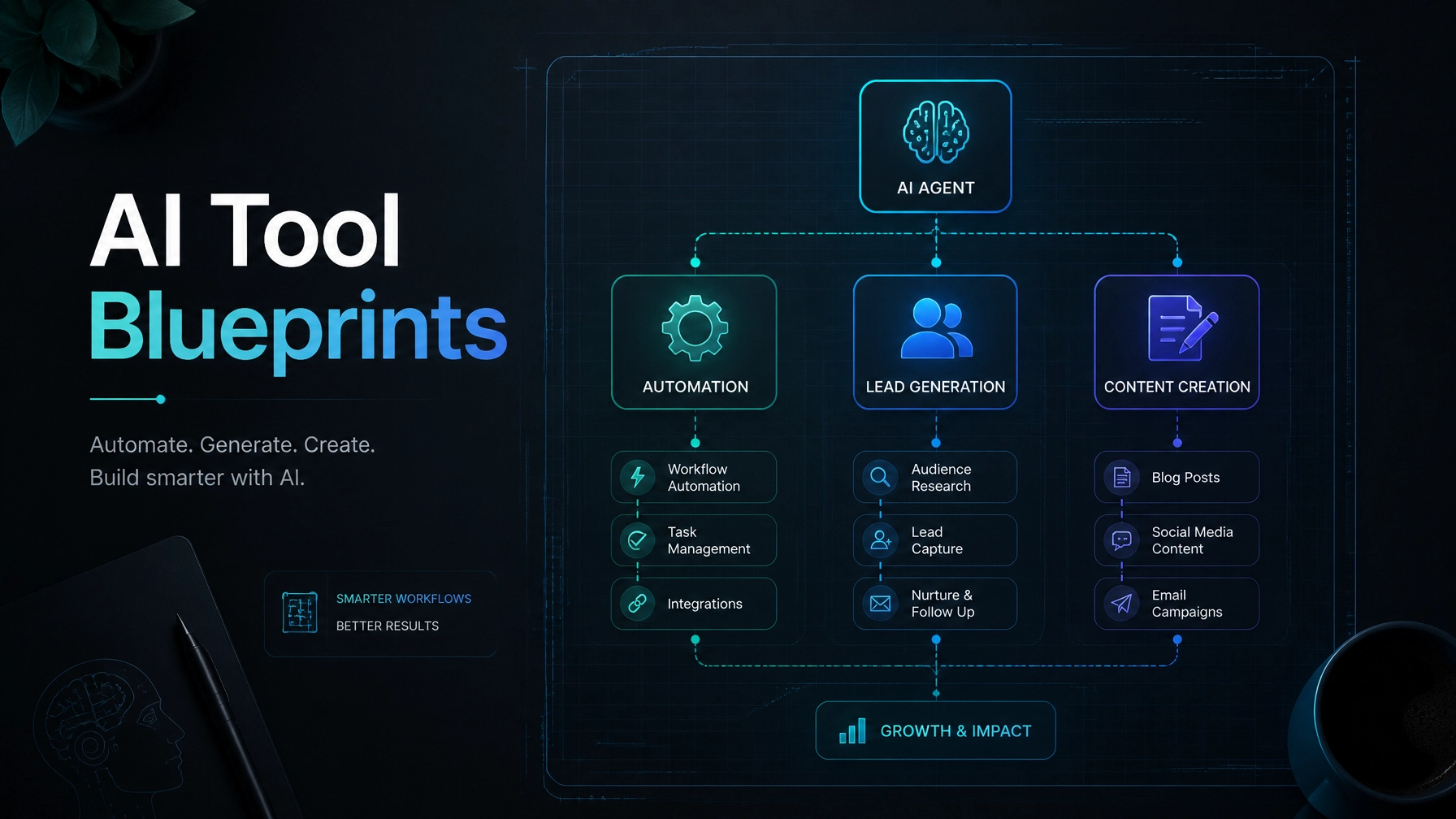
Let’s be honest: most small business owners are tired of the "AI hype." You’ve heard that ai tools for small business will change your life, but when you look at the sea of 10,000+ available apps, it feels like more work just to choose one than to actually do the manual task.
At Digital Genie, we don't believe in more software for the sake of software. We believe in operational efficiency. We see AI not as a shiny toy, but as a "team member" that can handle the heavy lifting while you focus on high-level strategy. If your current workflow feels like a series of manual bottlenecks: copying data, drafting repetitive emails, and struggling to find consistent traffic: you don't need a miracle; you need a blueprint.
The following 5-step blueprint is designed to help you cut through the noise, implement marketing automation ai, and build a scalable system that works while you sleep.

Step 1: Audit Your Friction (Find the Manual Leaks)
Before you buy a single tool, you must identify where your time is actually going. Automation for the sake of automation is just "faster chaos." You want to target repetitive tasks that follow a logical rule.
How to Conduct a Friction Audit:
- Track your time for 48 hours: Note every time you do a "copy-paste" action or send a standard response.
- Identify the "Brain-Dead" Work: These are tasks that don't require your unique expertise but must get done to keep the lights on (e.g., social media posting, lead data entry).
- Categorize by Outcome: Are these tasks related to Traffic, Leads, Content, or Automation?
By identifying these "manual bottlenecks," you create a shopping list for the best ai tools for small business that actually solve a problem instead of just adding to your subscription bill.
Step 2: Establish Your Traffic & Lead Engine
For most entrepreneurs, the biggest bottleneck is consistency. You might have a great offer, but if you only generate traffic when you have the energy to post on social media, your revenue will always be a roller coaster.
The goal here is frictionless visibility. You need tools that "feed" your business with attention without you having to manually film 50 TikToks a week.
Why Traffic Automation Matters:
Manual traffic generation is a trap. It relies on your personal bandwidth. By using a Traffic Generator AI, you can optimize AI-created content that distributes itself across search, news, and social platforms automatically.
What to use:
- Traffic Generator AI: This tool acts as your distribution hub, pushing your offer to news and social channels while targeting audiences by behavior and location. It’s about execution at a scale no human can match manually.
- Systeme.io: Once you have the traffic, you need a place for it to land. This is the "all-in-one" skeleton for your lead generation. It handles landing pages and email tools to convert those visitors into subscribers.
Execution Tip: Connect your traffic source directly to an automated landing page. Don't send people to a generic homepage; send them to a high-converting funnel that captures the lead immediately.
Explore the Traffic Generator AI Blueprint here

Step 3: Deploy AI "Team Members" for Content and Support
One of the hardest parts of scaling a small business is the "lonely founder" syndrome. You feel like you have to be the writer, the designer, the support agent, and the CEO.
In 2026, the best ai tools for small business are no longer just "calculators for text." They are AI employees. Think of these as digital support staff that handle the "messy" work of execution.
Who is on your AI Team?
- The Content Writer: Instead of staring at a blank page, use tools like Marblism to handle blog writing, social media management, and sales outreach.
- The Executive Assistant: AI agents can now handle scheduling, CRM updates, and even preliminary research for your client calls.
- The Support Agent: Use automated triage systems to handle 80% of common customer questions, only alerting you when a human touch is actually required.
By framing these tools as "team members," you shift your mindset from "managing software" to "managing a workflow." This is how you achieve scalable growth without burning out.
Hire your first AI Employees through Marblism

Step 4: Automate the Conversion (The "Webinar Clone" Strategy)
Traffic and leads are great, but they don't pay the bills: conversions do. The "old way" of selling involved being on "live" calls or webinars constantly. This is the ultimate bottleneck because your income is capped by your hours.
To scale fast, you need to clone your best salesperson (which is usually you).
Using Marketing Automation AI for Sales:
Imagine having a webinar that runs 24/7, looks live, interacts with customers, and closes sales while you are at dinner or asleep. This is what we call a Webinar Clone.
- Workflow Support: You record your best pitch once.
- Automated Execution: The AI handles the "live" chat triggers, the timing of the offer, and the follow-up emails for those who dropped off early.
- Outcome: You move from manual "one-to-one" selling to automated "one-to-many" selling.
This is the "plumbing" that turns a hobby into a business. It removes the friction of having to "show up" to make money.
Check out the WebinarClonesAI System
Step 5: Consolidate and Scale with a Central Hub
The final step in the blueprint is to stop looking for the "next big thing" and start mastering the tools you have. Most businesses fail at automation not because they have the wrong tools, but because their tools don't talk to each other.
You need a centralized system that organizes your tools by practical use cases. This is why we created the Digital Genie hub: to act as a "filter" that reduces software noise and focuses strictly on business results.
The Scaling Checklist:
- Standardize Your Stack: Don't use three tools for email when one (like Systeme.io) can do it all.
- Monitor Your ROI: Every marketing automation ai tool should either save you 5+ hours a week or generate more revenue than it costs.
- Invest in Your Skills: Automation isn't "set it and forget it." It's "set it and optimize it." Join a community or a membership that keeps you updated on how these tools are evolving.
By following this 5-step blueprint, you aren't just adding tech; you're building an AI-powered asset.
Join the Business Automation & Growth Membership

FAQ: Scaling with AI Tools
What are the best AI tools for small business owners just starting out?
For beginners, we recommend starting with an "all-in-one" platform like Systeme.io for leads and Marblism for content. These tools reduce the "software noise" by handling multiple parts of your workflow in one place.
Is marketing automation AI expensive?
Actually, it’s often cheaper than hiring a part-time virtual assistant. Most tools we curate at Digital Genie are focused on affordability for entrepreneurs and small businesses, often costing less than a few cups of coffee a day while providing 24/7 service.
How much time does it take to set up these AI blueprints?
Most of the tools we recommend focus on frictionless setup. You can typically have a traffic and lead engine running in less than a weekend. The key is to implement one step at a time rather than trying to automate everything at once.
Do I need to be a "tech person" to use these tools?
No. Our USP is that we focus on practical, easy-to-use tools. If you can use a smartphone and send an email, you can use these AI tool blueprints. We prioritize "no-code" solutions that focus on business outcomes rather than technical complexity.
Why should I trust Digital Genie for my AI tool recommendations?
We cut through the noise by curating tools around actual business outcomes (Traffic, Leads, Content, Automation) instead of just featuring random software. We are completely transparent about our affiliate relationships and only focus on tools we know work for entrepreneurs and small brands.
Ready to stop the manual grind?
Visit the Digital Genie Hub today to find the exact blueprint your business needs to grow smarter and faster.
Leave a Reply